A Day at the Microsoft AI Tour London

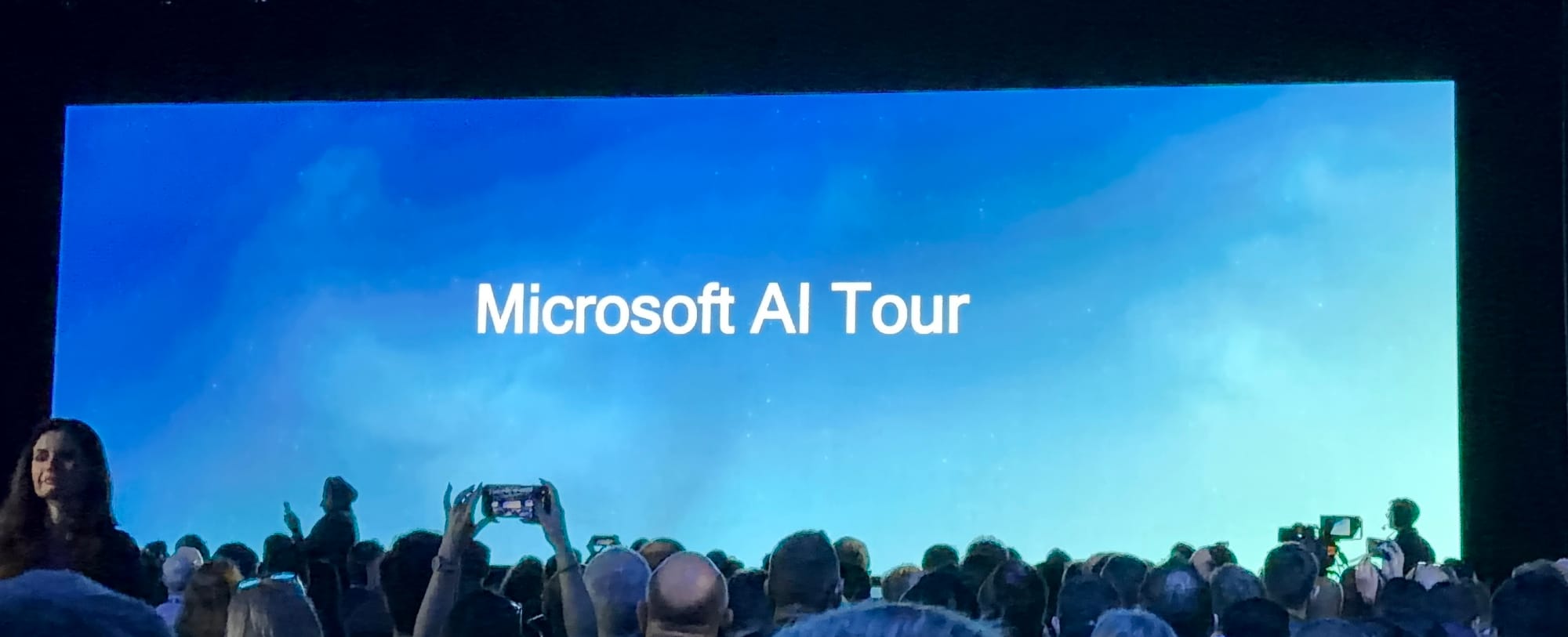
Earlier last week I had the opportunity to attend the Microsoft AI Tour in London, hosted at the ExCeL conference center. Like many technology events recently, this one centered entirely around artificial intelligence, but what made it particularly interesting was the shift in tone compared to conferences even a year ago. The conversation is no longer about whether AI is useful or impressive. That debate has largely been settled. Instead, the focus has moved to a more practical and arguably more interesting set of questions: how do we actually build, operate, secure, and scale AI systems in the real world?
I went into the day with a fairly packed schedule of sessions that covered everything from national AI strategy to multi-agent architectures and operational tooling. My plan was simple enough: attend as many talks as possible, absorb what the industry is doing, and leave with a clearer understanding of where Microsoft’s ecosystem is heading in the AI space.
As it turns out, the answer to that question kept appearing in session after session.
Agents.
Arriving at the Event
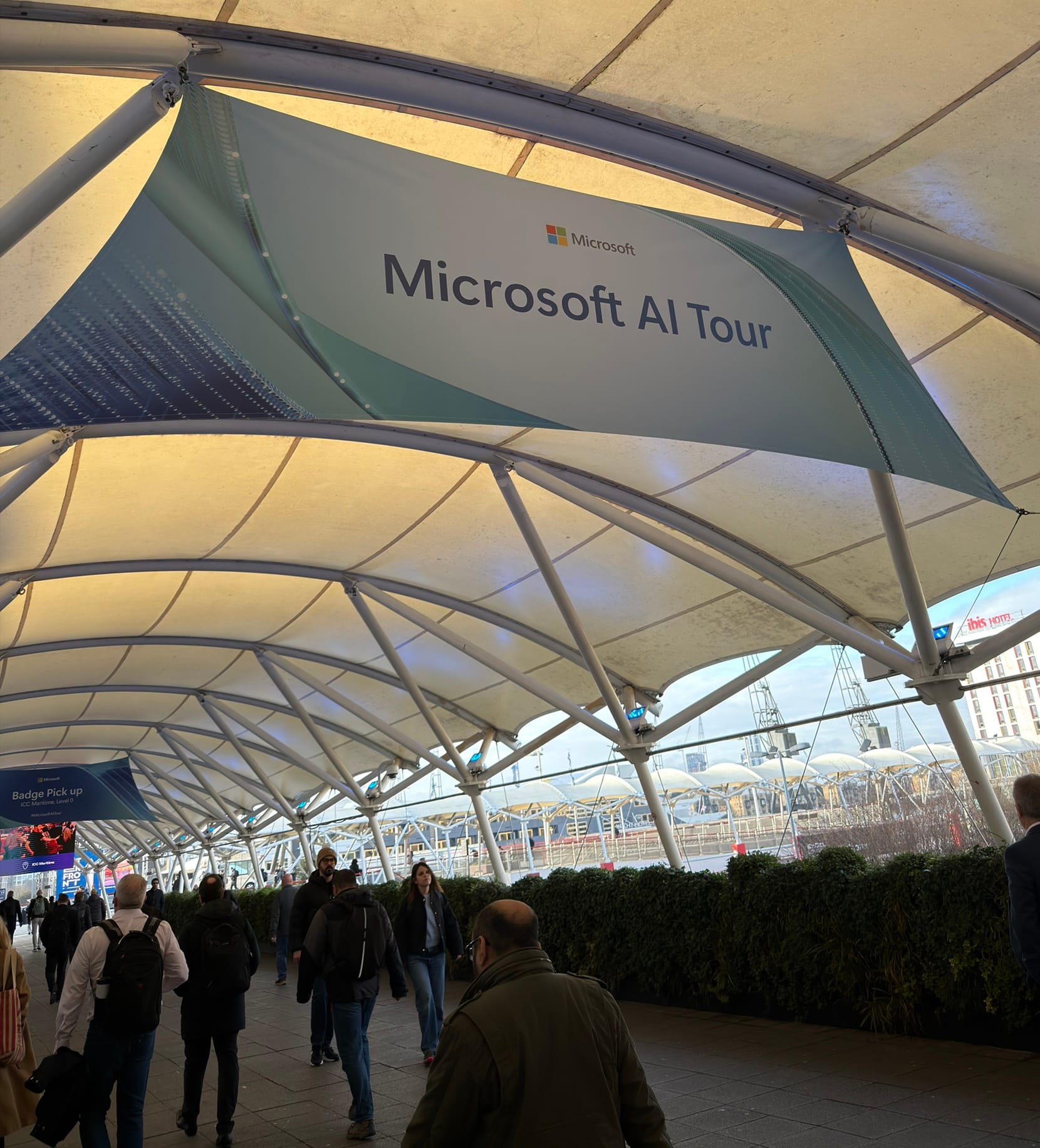
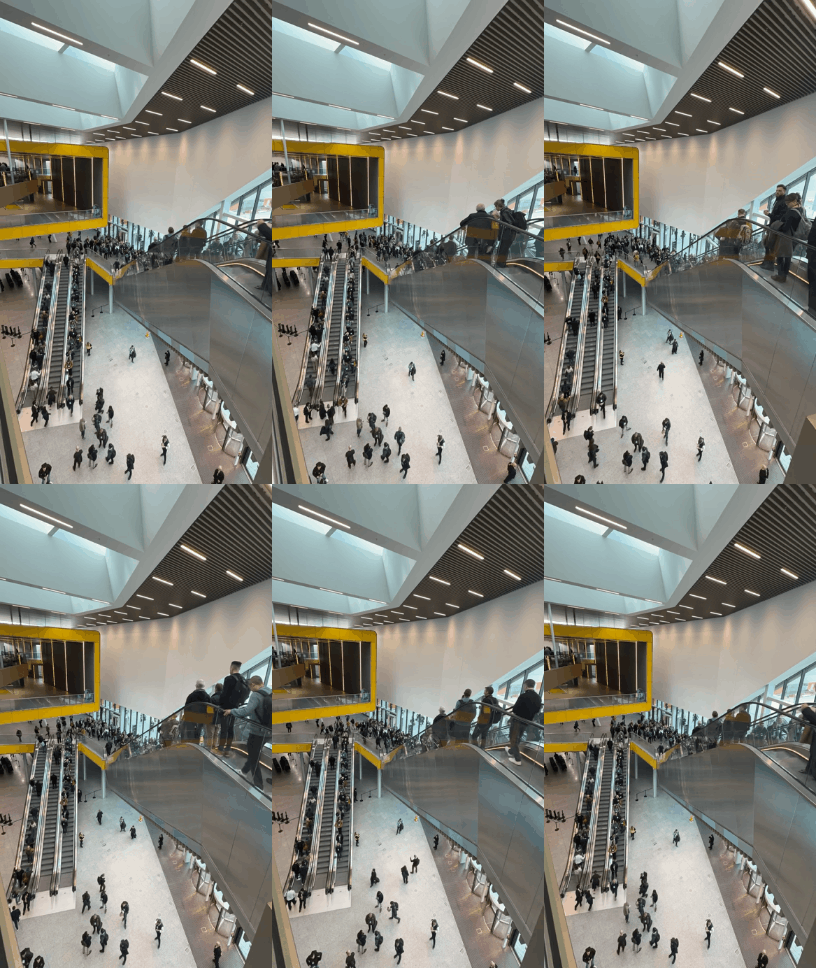
The ExCeL is no stranger to large technology events, but walking into the AI Tour still felt like stepping into a particularly busy airport terminal for developers. There were queues at registration desks, groups of engineers discussing Azure architectures over coffee, and the usual mix of attendees ranging from enterprise architects to startup founders.
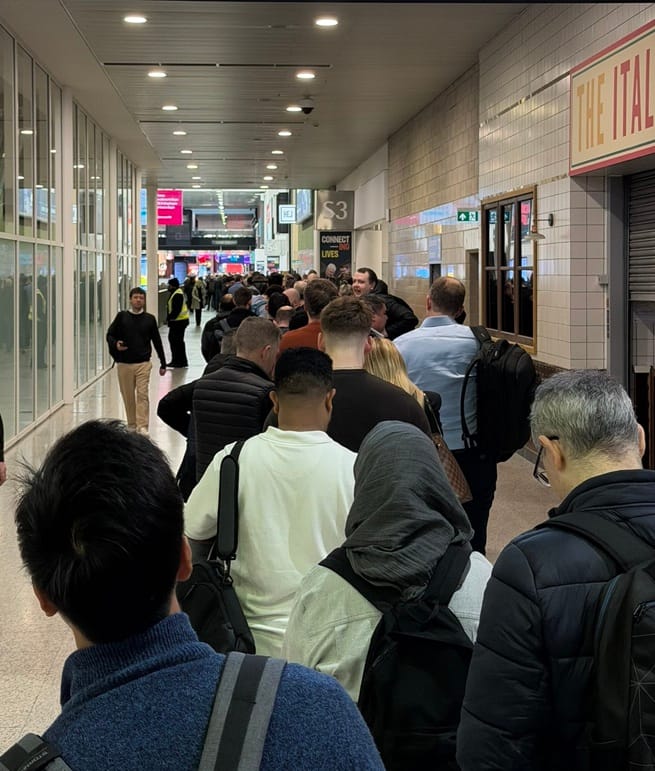
You can often tell the direction an industry is moving by the conversations happening in the hallways between sessions. Before the first talk even started, I had already overheard multiple discussions about multi-agent systems, vector databases, and the cost of running large language models in production. That alone says a lot about where things stand today. Not long ago people were still asking whether LLMs were more than a novelty. Now the conversation is about operational costs and security controls.
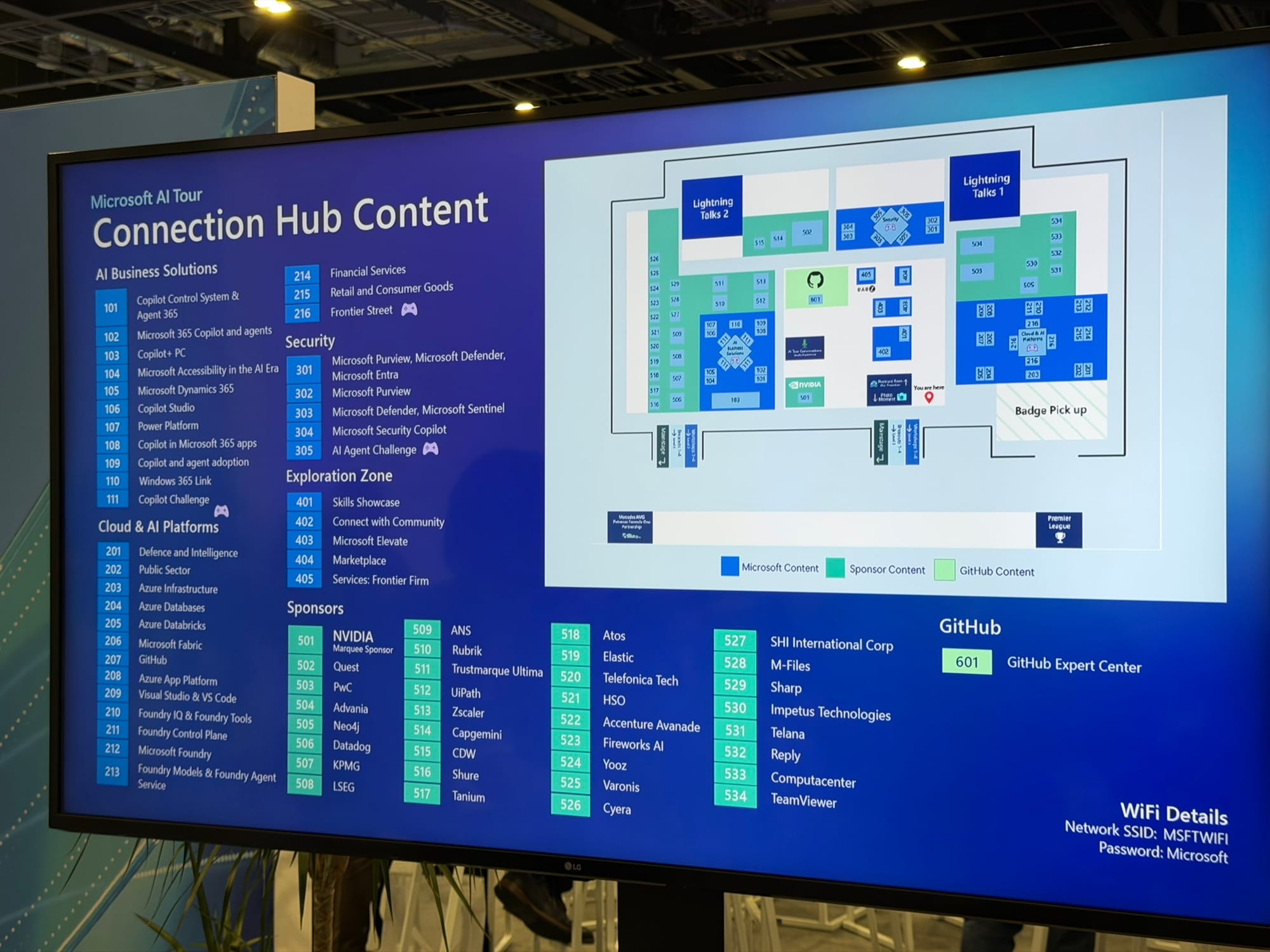
After grabbing a coffee and orienting myself around the venue, it was time to head to the mainstage for the first session of the day.
Building the UK's AI Frontier
The opening session I attended was titled Building the UK's AI Frontier, and it served as a broad overview of how Microsoft views the UK’s role in the rapidly evolving AI ecosystem.
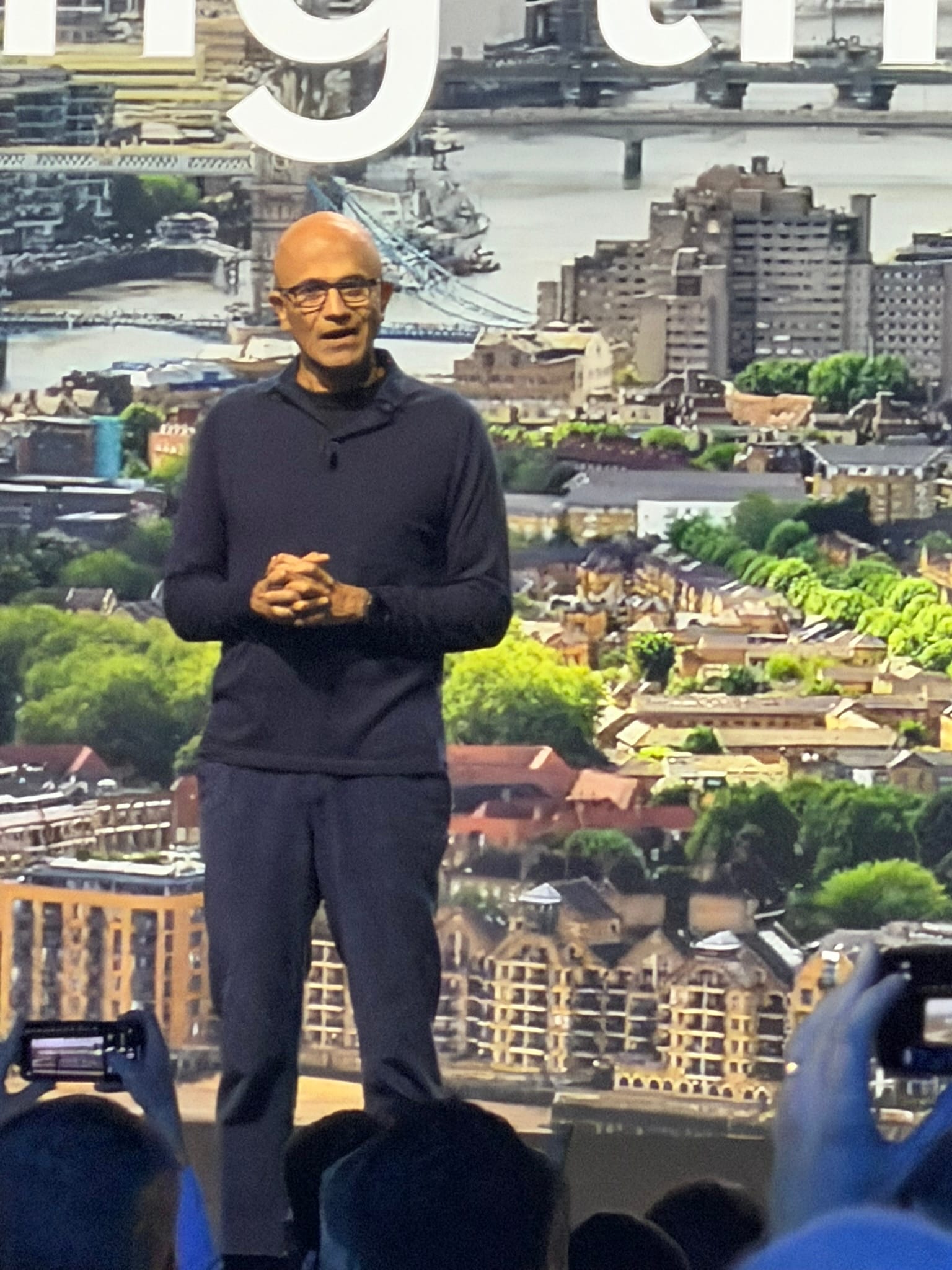
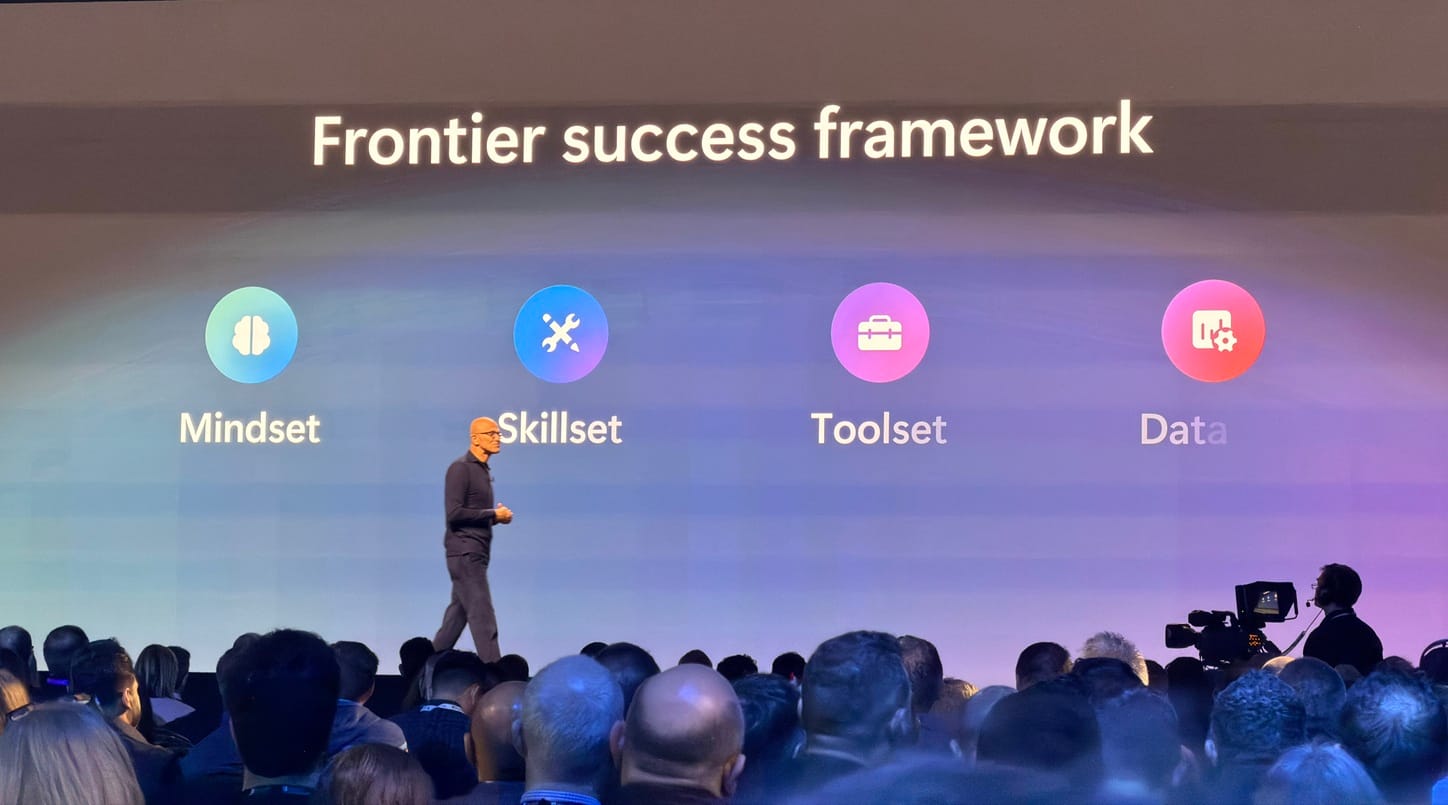
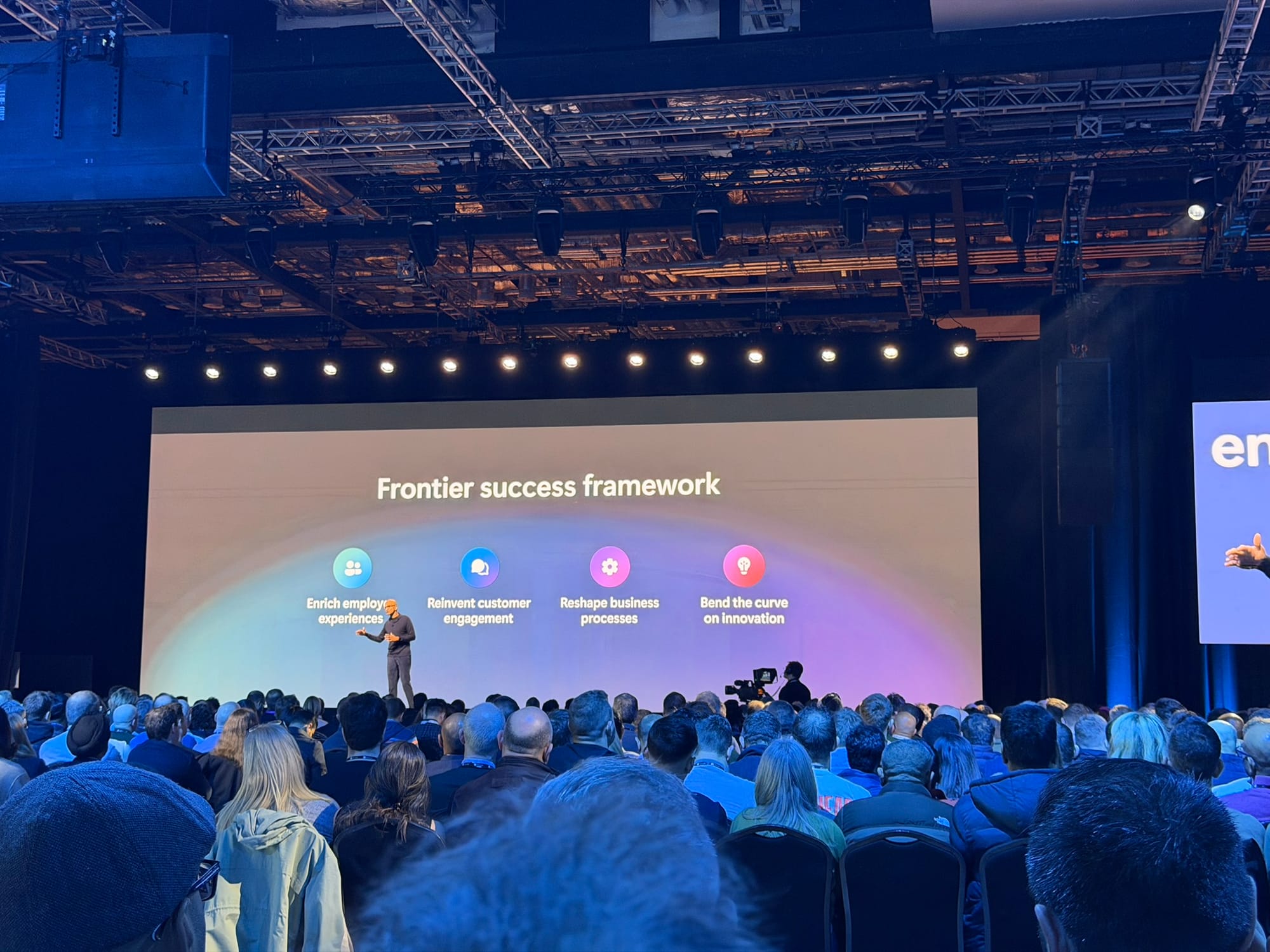
The discussion covered several areas including infrastructure investment, workforce skills, and responsible development. One of the major themes was the increasing importance of cloud infrastructure capable of supporting large scale AI workloads. Training and running modern AI models requires enormous computational resources, and cloud providers are essentially becoming the backbone of that infrastructure.
The UK has positioned itself as a key hub in this landscape, with continued investment in Azure regions and high performance compute designed specifically for AI workloads. While a lot of headlines around AI focus on model breakthroughs, this talk reminded everyone that none of those models run in a vacuum. They require massive amounts of compute, storage, networking, and orchestration to function reliably.
Another point raised during the session was the shift from experimental AI projects to production systems. Many organisations have already gone through the phase of building prototypes and proof-of-concepts. The next challenge is integrating those systems into existing enterprise environments where security, compliance, and reliability requirements are significantly higher.
In other words, building a cool AI demo is one thing. Running that same system in a regulated industry with millions of users is something entirely different.
Guardrails for AI Applications
The next session I attended was a short lightning talk about protecting AI applications and large language models with real time guardrails. Despite being relatively brief, it touched on one of the most important topics in modern AI development.
When people first started experimenting with LLMs, the focus was almost entirely on prompt engineering and model capabilities. Over time it has become clear that deploying these systems safely requires additional layers of protection. Unlike traditional software components, AI systems can behave unpredictably depending on how they are prompted and what data they encounter.
The concept of guardrails is essentially about creating boundaries around AI behaviour. These can include mechanisms for detecting prompt injection attempts, filtering outputs, enforcing policy rules, and preventing models from interacting with sensitive systems in unintended ways.
One example discussed involved tool usage within agent based systems. If an AI model is allowed to call external tools such as APIs, databases, or automation scripts, it becomes essential to control what those tools can do and under what circumstances they can be invoked. Without those constraints, you risk creating systems that can be manipulated through carefully crafted prompts.
This idea came up repeatedly throughout the day. As AI systems gain the ability to perform actions rather than simply generate text, the importance of runtime safety mechanisms increases dramatically.
Lunch and Conversations in the Hallways
Lunch at technology conferences tends to follow a familiar pattern. You collect a plate of food, find somewhere to sit, and within minutes you are discussing architecture decisions with people you have only just met.
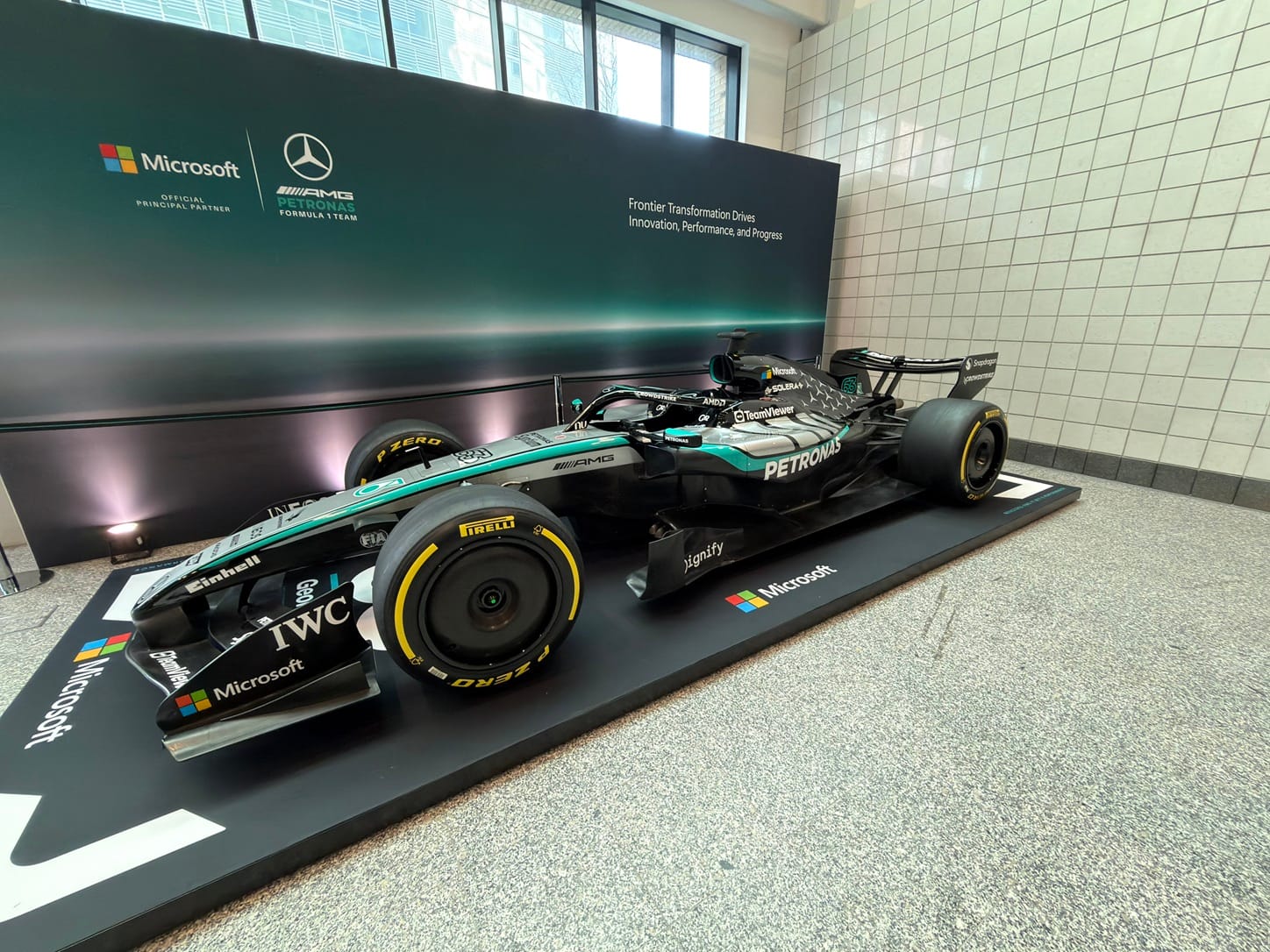

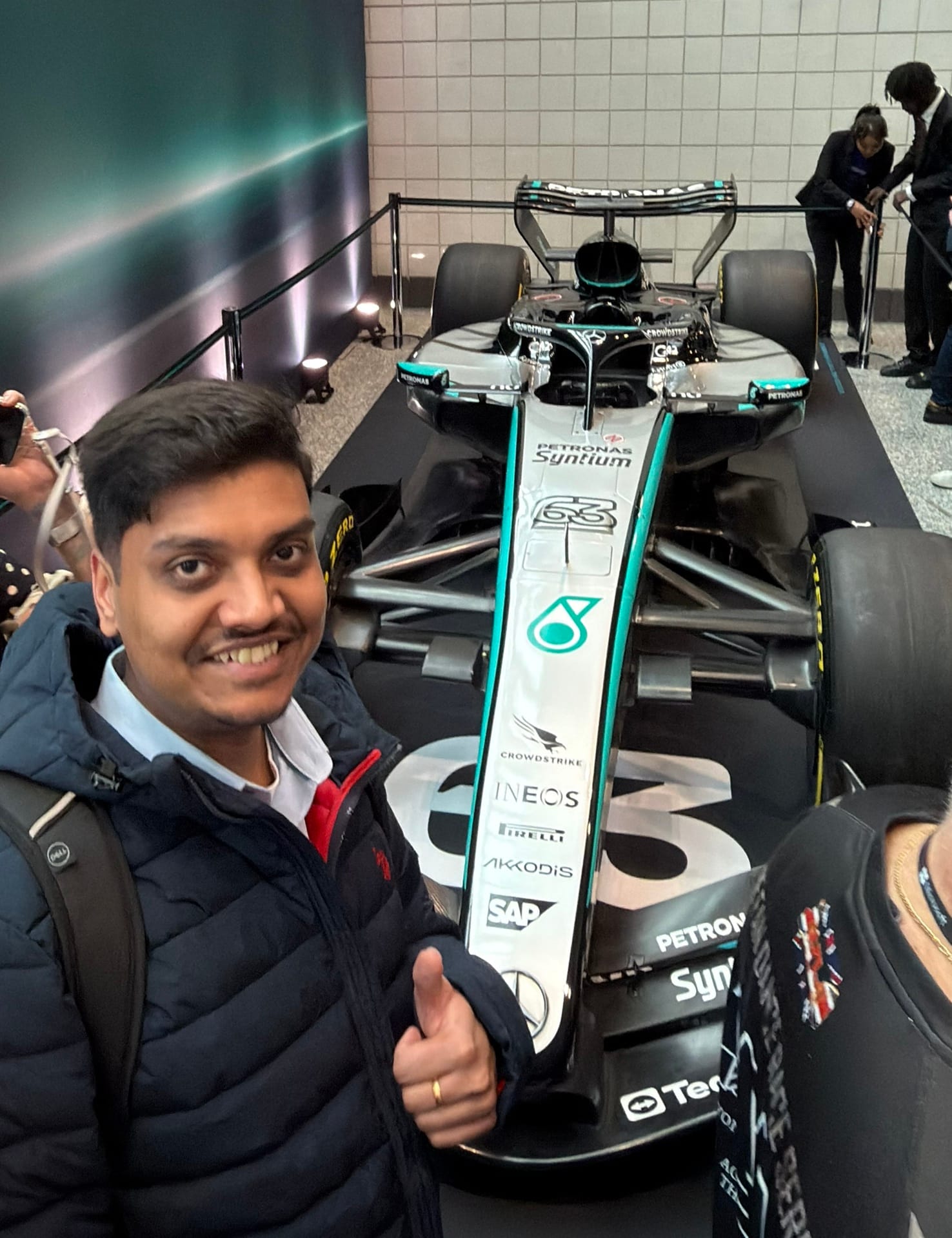
The conversations I had during the lunch break were just as valuable as the talks themselves. Several attendees were working on enterprise AI platforms, while others were experimenting with agent orchestration frameworks. One recurring topic was the cost of running large language models at scale. While cloud providers continue to release increasingly powerful models, the financial implications of running them continuously in production environments can quickly become significant.
Another theme that kept surfacing was the challenge of moving from prototype to production. Many teams have successfully built AI powered tools internally, but integrating those tools with legacy systems, governance frameworks, and security policies can be considerably more complicated than the initial development work.
Despite these challenges, the overall mood was one of cautious optimism. Most people seemed to agree that AI will fundamentally reshape how software systems are built, but that transformation will require careful engineering rather than blind enthusiasm.
AI in Healthcare
After lunch I attended a lightning talk focused on the healthcare sector, specifically how intelligent automation and speech recognition technologies can support clinicians within the NHS.
Healthcare systems generate enormous amounts of documentation, and clinicians often spend a significant portion of their time performing administrative tasks rather than interacting directly with patients. AI powered transcription and automation tools aim to reduce that burden by capturing conversations, generating structured notes, and integrating those notes into electronic health records.
The Dragon platform, which has been used in medical transcription for many years, is evolving to incorporate modern AI capabilities that can understand context and produce more accurate clinical documentation. While these tools are not intended to replace medical professionals, they can significantly improve workflow efficiency.
Anyone who has worked in or around public sector systems understands the complexity involved in introducing new technology into healthcare environments. Regulatory requirements, data privacy concerns, and interoperability challenges all add layers of difficulty. Seeing practical implementations in this space was encouraging because it demonstrated that AI can deliver tangible improvements when applied thoughtfully.
Security in the Age of Agentic AI
One of the most interesting sessions of the afternoon focused on security in the age of agentic AI. The term “agentic” refers to systems that are capable of reasoning about tasks, making decisions, and performing actions autonomously or semi autonomously.
Traditional software systems operate within relatively predictable boundaries. An application receives input, processes it according to defined logic, and produces output. AI agents introduce a new dimension because they can dynamically decide which tools to use and how to achieve a goal.
This flexibility is powerful but also introduces new security challenges. If an AI agent has access to APIs, internal systems, or external services, the potential attack surface expands considerably. Malicious prompts could attempt to manipulate the agent into performing unintended actions, exposing sensitive information, or interacting with systems in unsafe ways.
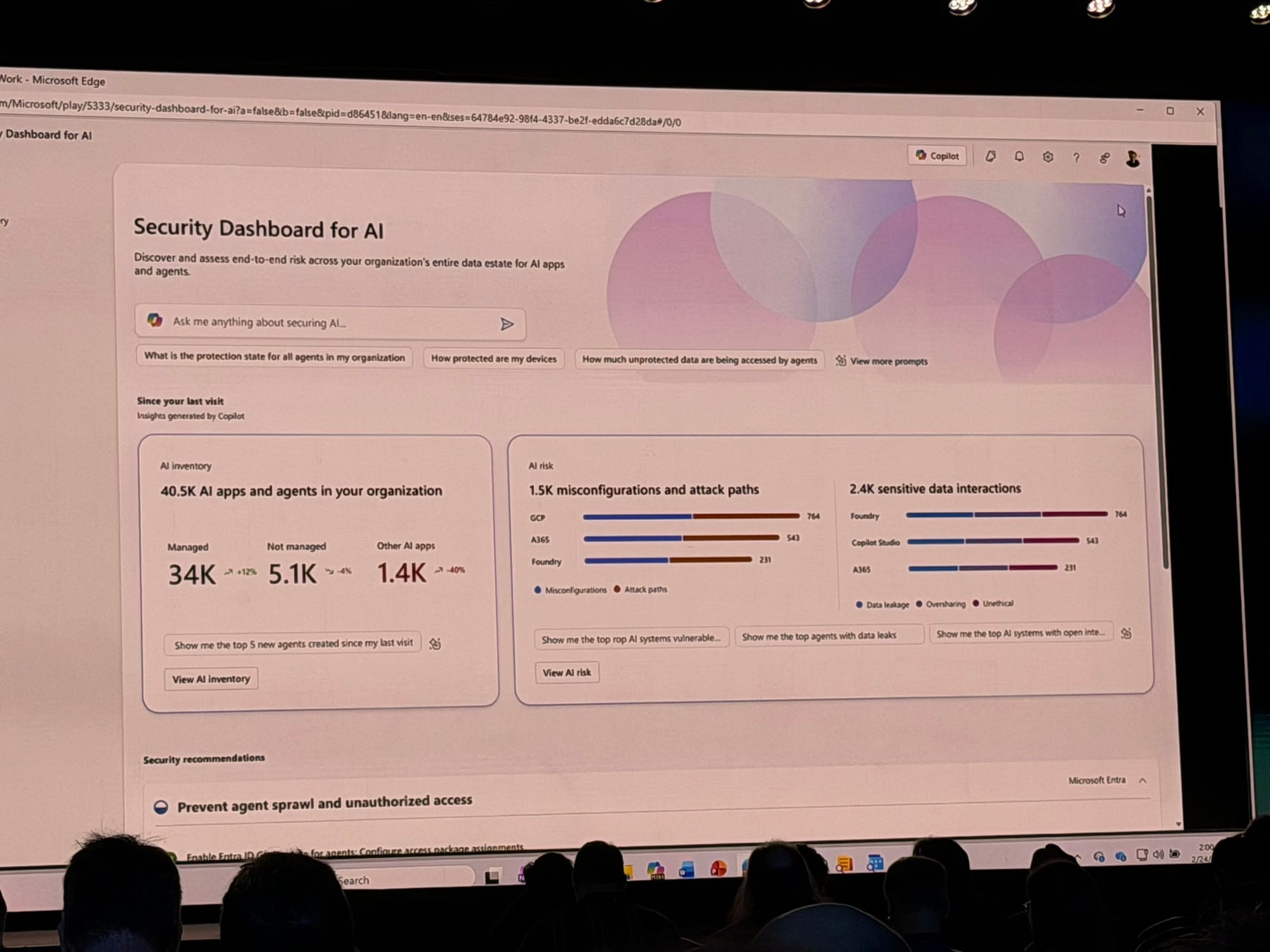
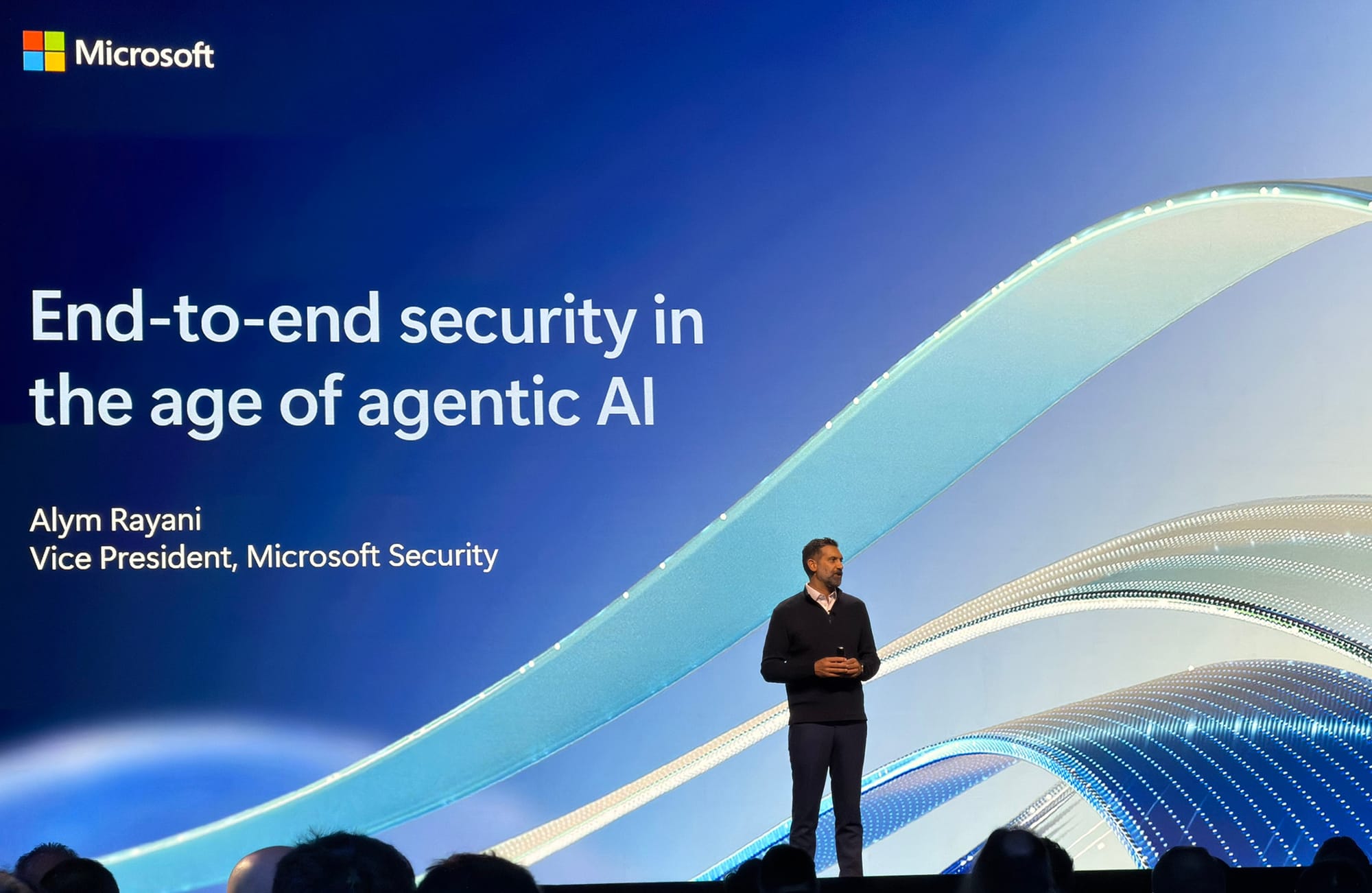
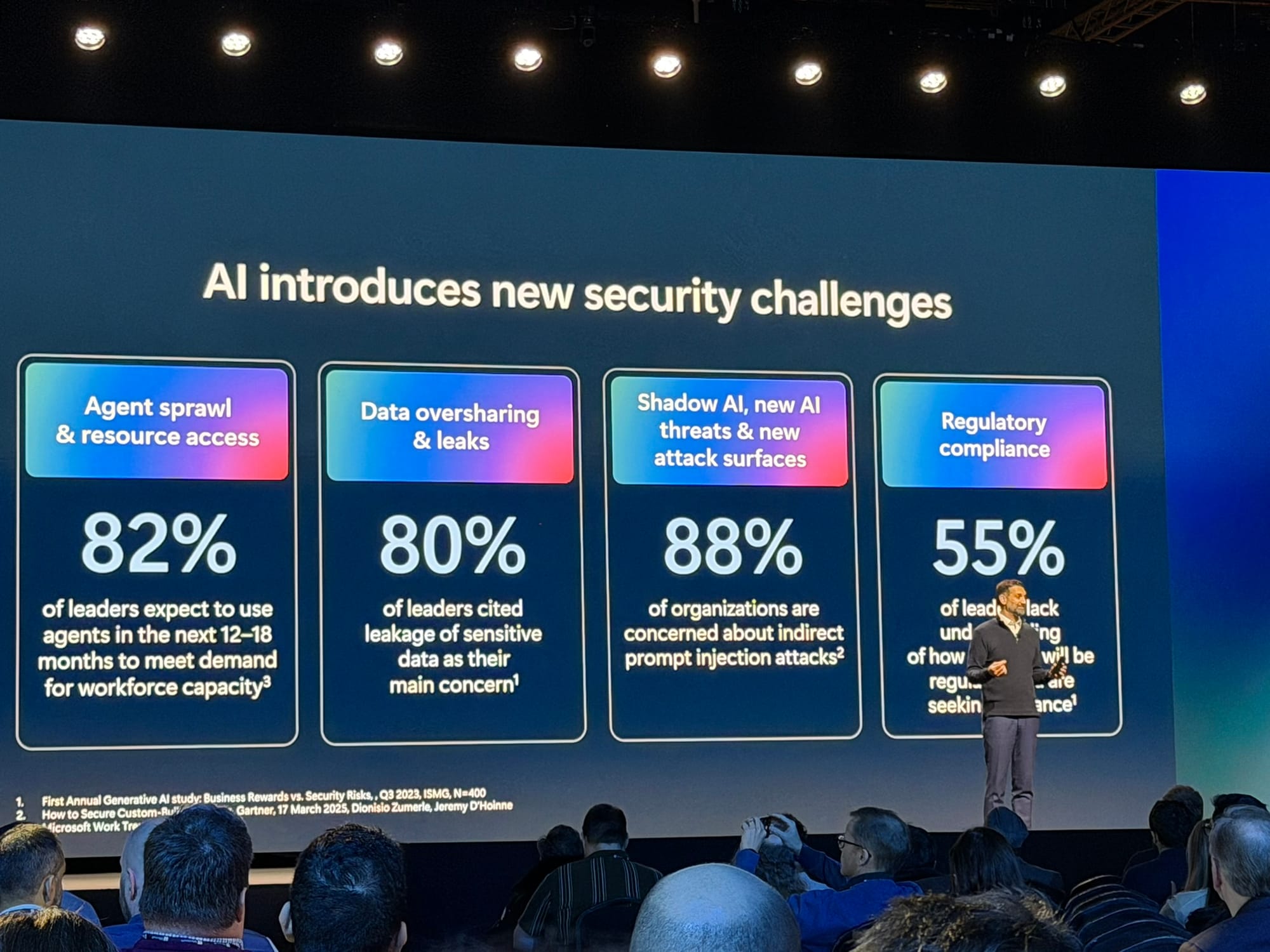
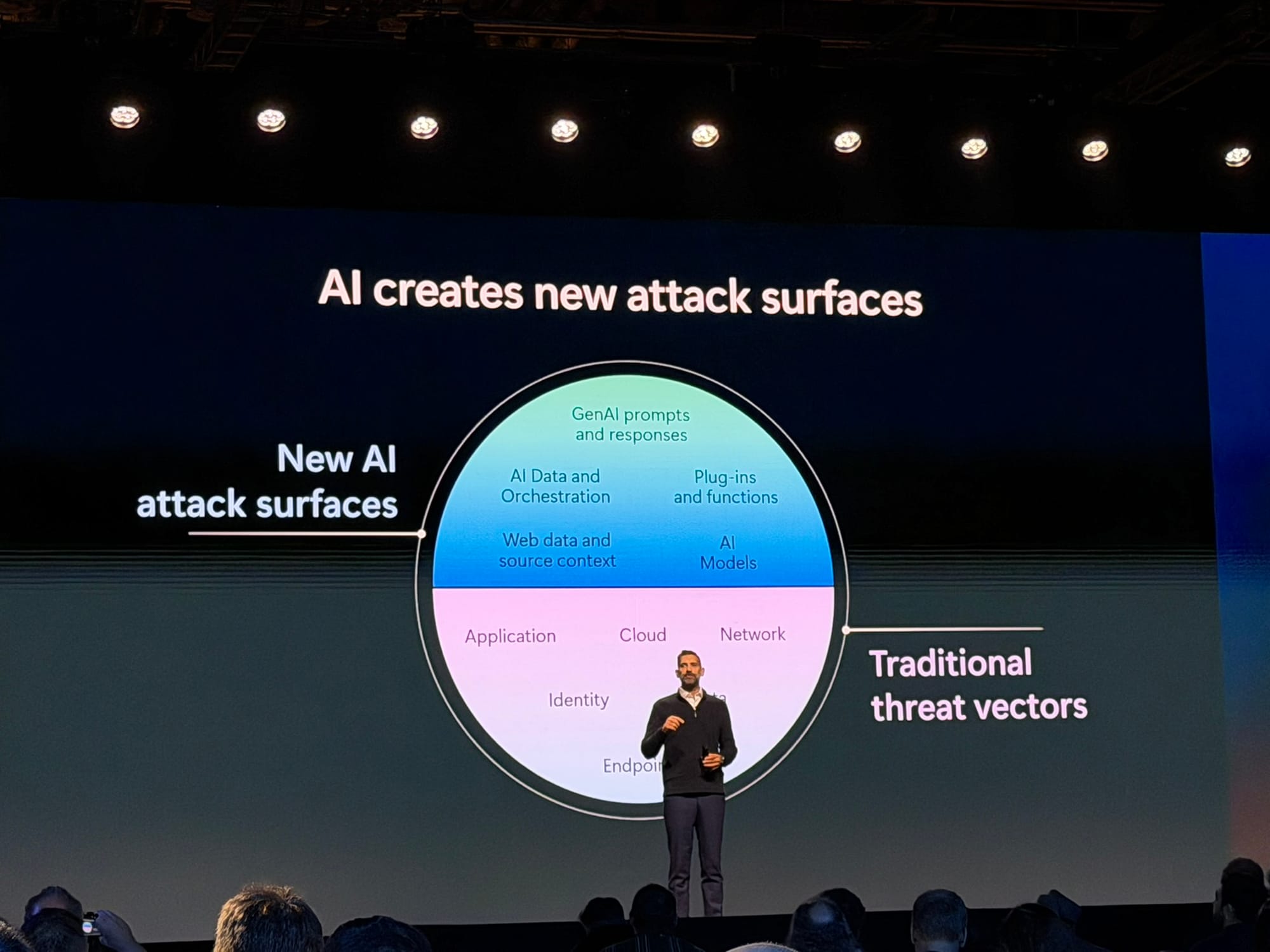
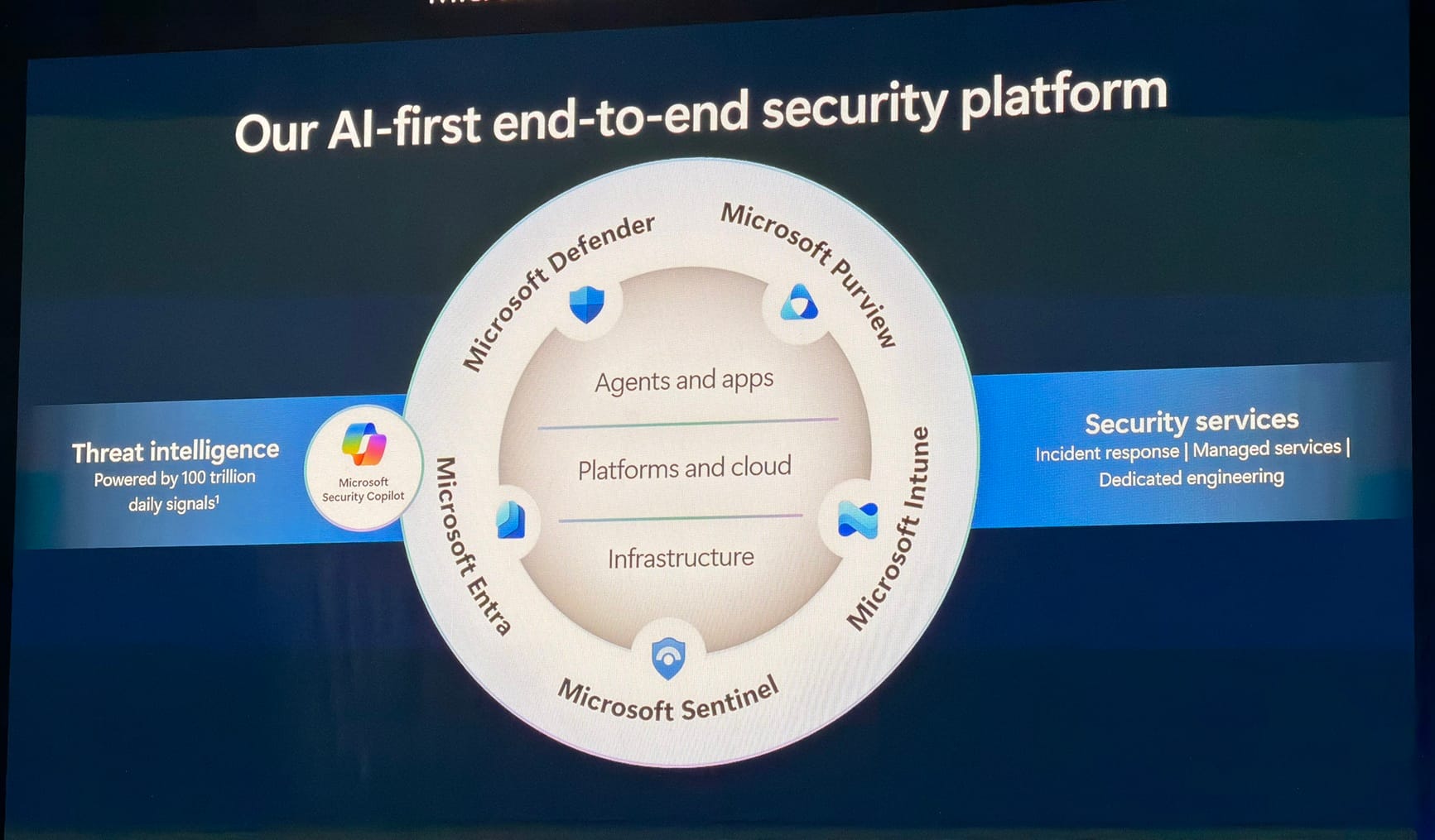
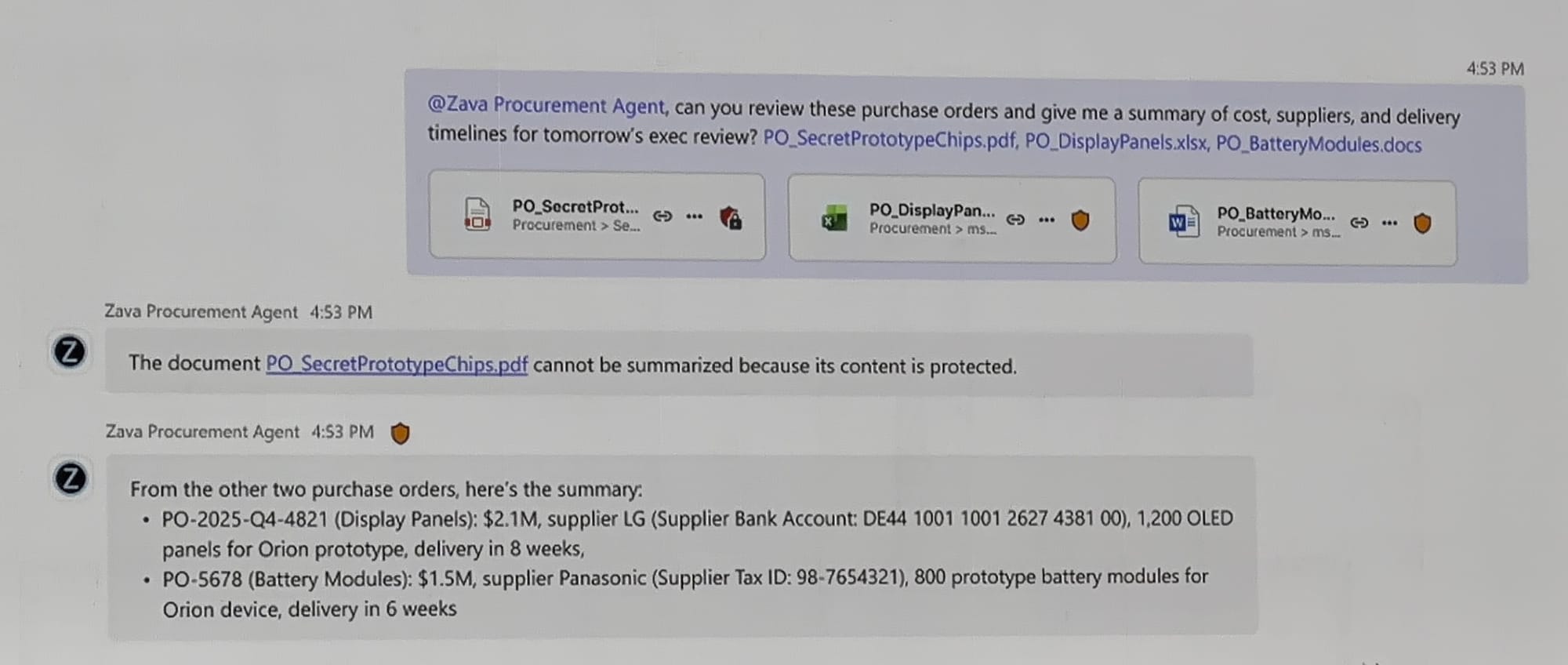
The session explored how modern security architectures must evolve to address these risks. Monitoring AI behaviour, validating tool usage, and enforcing strict access controls become critical components of any agent based system. The idea is to treat AI agents as semi trusted actors within the system rather than fully trusted components.
Shortly after this talk, another lightning session introduced Security Copilot, Microsoft’s generative AI powered assistant for security teams. The goal is to help analysts interpret security signals more efficiently by summarising threat intelligence, analysing incidents, and suggesting potential responses.
Given the increasing complexity of modern cyber threats, tools that augment human analysts could make a significant difference. Security teams often deal with overwhelming volumes of alerts, and AI assisted investigation workflows may help reduce that burden.
Video Analytics and AI Agents
Another fascinating talk explored the intersection of AI agents and video analytics using NVIDIA technologies on Azure. Video data represents one of the largest and most underutilised sources of information in many industries, from manufacturing and logistics to public safety.
Vision language models are beginning to bridge the gap between raw visual data and high level reasoning. Instead of simply detecting objects within a frame, these models can interpret scenes and answer questions about what is happening.
When combined with agent based architectures, the possibilities become even more interesting. An AI system could analyse video feeds, identify unusual patterns, and trigger automated responses. For example, it might detect safety violations in an industrial environment or identify operational issues in real time.
Running these workloads at scale requires substantial compute resources, which is where the Azure and NVIDIA partnership becomes particularly relevant. High performance GPUs and optimised AI infrastructure enable these models to operate with the speed and reliability required for production environments.
Reliability Engineering with AI
Later in the afternoon there was a short but intriguing talk about the concept of an Azure Site Reliability Engineering agent. Anyone who has spent time managing large distributed systems understands the challenges of maintaining reliability across complex cloud environments.
Modern applications generate massive volumes of telemetry including logs, metrics, and traces. Analysing that data during an incident can be time consuming, especially when engineers are under pressure to resolve issues quickly.
The idea behind an SRE agent is to provide an AI assistant capable of interpreting operational data, identifying potential root causes, and recommending remediation steps. Rather than replacing human engineers, the agent acts as a form of augmented intelligence that helps navigate complex systems more efficiently.
For engineers who have experienced the joy of being woken up by production alerts in the middle of the night, the prospect of an AI assistant helping diagnose problems is quite appealing.
The Emergence of Multi Agent Systems
As the day progressed, one concept kept appearing across multiple sessions: multi agent architectures.
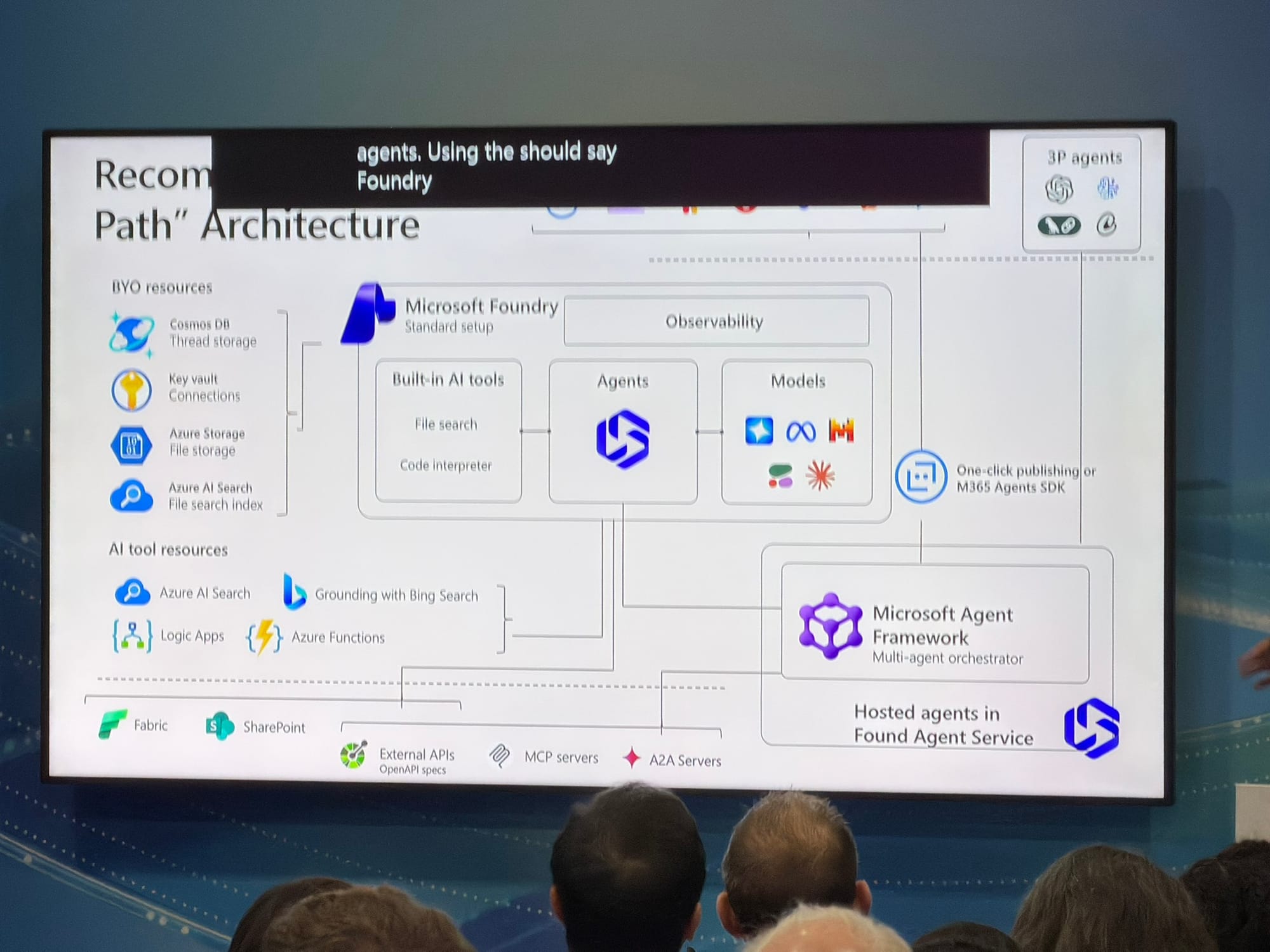
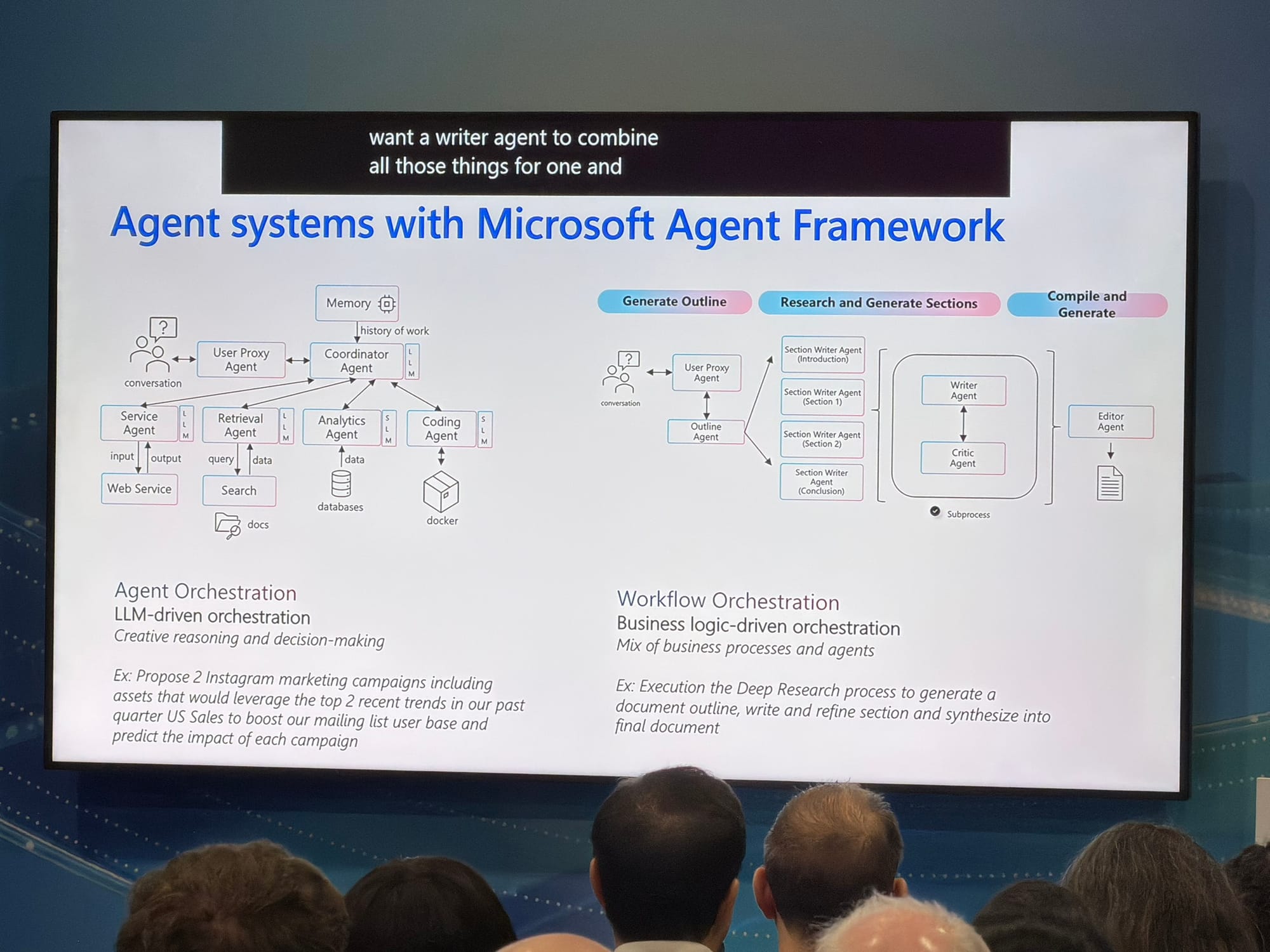
The Microsoft Agent Framework session introduced tools designed to help developers build systems composed of multiple specialised agents that collaborate to complete tasks. Instead of relying on a single monolithic AI model, developers can create a collection of agents with distinct roles.
One agent might focus on planning and breaking down a task into steps. Another might perform research or retrieve relevant information. A third could interact with external tools or APIs, while a fourth verifies the results before presenting them to the user.
This approach mirrors how human teams operate. Complex problems are rarely solved by a single individual working in isolation. Instead, different specialists contribute their expertise to achieve a shared objective.
From an architectural perspective, multi agent systems also offer advantages in terms of modularity and scalability. Each agent can be developed, tested, and improved independently while still contributing to the overall workflow.
Are We Still Building Tools for Humans?
One of the most thought provoking talks of the afternoon explored the changing nature of developer tools. The session was titled DevTools or AgentTools, and it posed an interesting question about the future of software engineering.
Historically, developer tools have been designed primarily for human users. Documentation, APIs, and interfaces assume that a person will be reading instructions and writing code accordingly.
If AI agents increasingly interact with software systems on our behalf, that assumption may change. We might begin designing tools specifically for machine consumers rather than human developers. APIs may evolve to provide clearer semantic structures that agents can interpret more effectively, and documentation might be structured in ways that allow AI systems to navigate it more easily.
This shift could have profound implications for how platforms and services are built. It suggests that the next generation of developer tooling might be designed as much for AI collaborators as for human engineers.
Orchestrating Agents with Microsoft Foundry
The final technical session I attended focused on orchestrating agents using Microsoft Foundry. This platform aims to provide the infrastructure required to manage complex agent based workflows, including context management, tool integration, and execution orchestration.
As agent systems grow more sophisticated, coordinating their activities becomes increasingly important. Without proper orchestration, multiple agents attempting to solve a problem simultaneously could create chaos rather than efficiency.
Foundry appears to address this challenge by providing mechanisms for controlling how agents interact, share information, and execute tasks. The platform essentially acts as a coordination layer that ensures agents operate in a structured and predictable manner.
From a developer perspective, this kind of orchestration framework could significantly simplify the process of building large scale AI systems. Instead of manually managing interactions between agents, developers can rely on platform level capabilities to handle much of the complexity.
Ending the Day with AI Trivia
The final event of the day was something a little lighter: an AI trivia session hosted by Microsoft and NVIDIA.
After several hours of technical talks, it was refreshing to see the atmosphere shift into something more relaxed. Teams competed to answer questions about AI history, machine learning concepts, and technology milestones.
Some questions were surprisingly challenging, while others produced confident but incorrect answers shouted enthusiastically from the audience. Technology trivia tends to do that.
Regardless of the results, it was a fun way to wrap up the day and gave everyone a chance to unwind before heading home.
Reflections on the Day
Leaving the ExCeL at the end of the event, I found myself thinking about the recurring themes that had appeared across nearly every session.
The first and most obvious takeaway was the rise of AI agents as a fundamental architectural pattern. Rather than simply embedding AI models into existing applications, developers are beginning to design entire systems around collaborative agents capable of reasoning and acting.
The second major theme was security and governance. As AI systems gain access to tools, data, and operational workflows, ensuring safe behaviour becomes critical. Guardrails, monitoring, and policy enforcement will likely become standard components of AI architectures.
Finally, there was a clear emphasis on operational maturity. The industry is moving beyond experimentation and towards building production ready AI systems that must meet the same reliability and scalability standards as any other enterprise technology.
In many ways, the AI industry is entering a phase that feels familiar to anyone who has worked in software engineering for a while. The early excitement around new capabilities is gradually being replaced by the practical realities of building robust systems.
And honestly, that is where things start to get really interesting.
Because once technology moves from experimentation into production, it becomes part of the infrastructure that shapes how organisations operate and how people work.
The next few years will likely see rapid innovation in agent orchestration, AI security, and operational tooling. The tools we use to build and manage software systems may look very different as AI becomes more deeply integrated into the development process itself.
If the Microsoft AI Tour demonstrated anything, it is that we are only at the beginning of that transformation.
And if the promise of AI powered SRE agents eventually means fewer late night production incidents for engineers everywhere, that alone might be reason enough to keep watching this space closely.